Getting To Know Your Everhot – A Guide To Cooking On Your New Electric Range
Congratulations! Your new Everhot electric range cooker is installed, your newly transformed kitchen is looking exactly as you wanted it, and you’re ready to start cooking. But there’s one thing that might take a little longer to settle in, and that’s getting used to how your Everhot works, especially if you’re switching from a standard cooker with a gas or induction hob.
To help with those first-week frustrations and give you some side-by-side comparisons between Everhot and AGA cookers, this quickstart guide should answer some of your immediate questions. So, let’s get to know your Everhot.
Understanding how your Everhot works
Before you purchased your cooker, you studied the facts and stats, researched its energy consumption and running costs, and chose the model that meets all your kitchen needs. But actually using it on day one can take some adjusting to. Here’s a rundown of some of the biggest functions that will make your first week easier.
Radiant heat
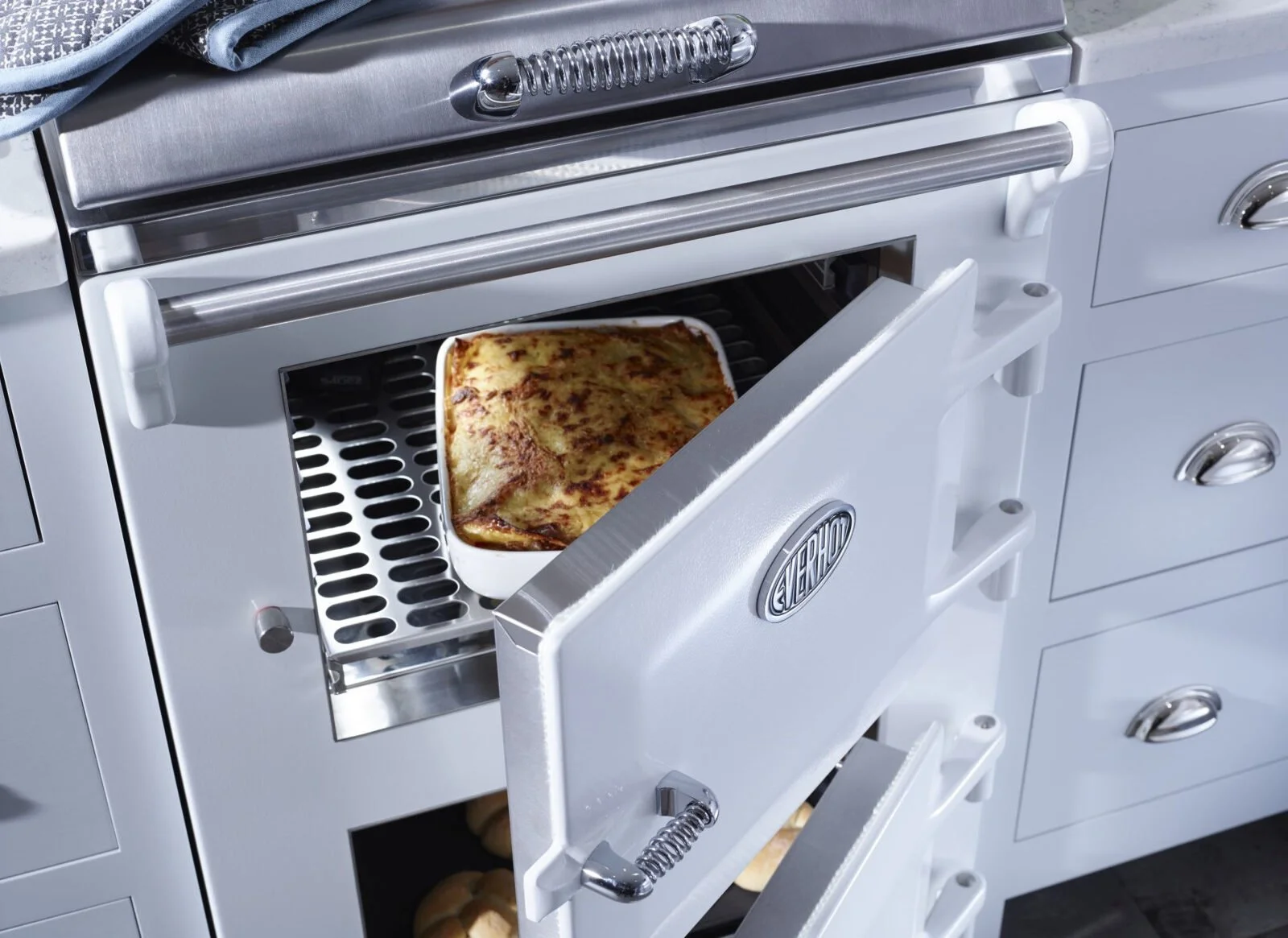
A big adjustment for new Everhot users is the cooker’s use of radiant heat. Just like an AGA or a Rayburn, your Everhot cooker uses indirect, radiant heat stored in its thick-walled steel ovens to cook or warm your food. This differs from standard ovens that use direct heat from a gas flame or an exposed, heated element.
Your cooking times might not always match what you’re used to with a standard gas or electric oven, and you won’t be able to instantly turn the heat up or down the same way. That means working with less immediate control while you cook.
But you’ll learn to love and trust the cooking process, because radiant heat creates a gentler, more even cook for roasts, bakes, or slow-cooks, and keeps food moist and less likely to dry out.
Heat-up times
One of the biggest adjustments to get used to with your Everhot cooker is its heat-up times. While conventional gas and electric ovens can heat up relatively quickly (in around 10-15 minutes), your Everhot will need around 2 hours to reach full working temperature from cold, and around 40 minutes for the hotplates – though considerably less when you use the ECO settings.
That might sound like a long time, but compared with an AGA heat-up time of up to 8 hours, it’s actually pretty quick. However, if you’re used to a conventional oven and the almost instant heat of a gas or electric hob, you might think that something’s wrong. There isn't – it just takes a bit of getting used to.
All Everhot models also include an Oven Delay Timer for energy efficiency, so you can decide exactly when the hotplates and ovens warm up. The standard setup allows around 3 hours between the hotplates heating and the ovens reaching temperature later. You can delay that by up to 12 hours, which is perfect if most of your cooking happens in the evening.
And one final heat-up tip for you – if you need to boost the top oven temperature in a hurry, the closed-door grill function can help it get back to its preferred temperature quickly.
Factor the heat-up times into your meal prep to avoid any last-minute disappointment, and remember – all good things come to those who wait.
Hotplate usage
All Everhot cookers feature two hotplates – one for boiling and one for simmering. Depending on your model, you may have four hotplates, and even an induction hob for speed, precision, and energy efficiency. But as the names suggest, one is used for high-heat boiling at around 340ºC, and the other for gentle cooking and simmering at around 220ºC.
Unlike an AGA, each hotplate (and oven) is independently temperature-adjustable, so there’s no need to run it at a fixed temperature all the time. But if you need to adjust it, remember it won’t respond instantly like a gas or electric hob.
The idea is to heat the plates and keep them at their optimum temperature, then move your pans between the boiling and simmering plates as you cook. This can be tricky to get used to, but once you find your rhythm, you’ll find you probably won’t need to adjust the temperatures at all.

ECO mode
To give you real energy savings, the Everhot also features ECO mode. This super-convenient function can automatically lower the cooker’s oven and hotplate temperatures by up to 50% during set quiet times or overnight. It then warms back up to full heat, ready for your next cooking session.
With the flexibility to programme your Everhot via the control panel or app for specific times, the ECO controllability function is a small but effective piece of technical brilliance. It’s also a genuine energy– and cost–saving addition to every Everhot model. While it can save up to 20% on total energy use, it could also slash running costs to as little as £15 per week.
That’s way more than a traditional oil or gas AGA that’s on 24/7.
Getting the most from your Everhot
These insights into four of the biggest Everhot features should help make your first week go a little more smoothly as you learn to adjust to – and love your new cooking partner.
If you need more information on anything in the Everhot world, explore our full range of Everhot cookers online. Alternatively, visit our F & R Fornello showroom in Forest Row, East Sussex or contact us for more expert advice.