Everhot vs AGA Cookers: Which Is Right For Your Home?
Choosing between an Everhot and an AGA is not just about cooking performance. It is about how you want your kitchen to feel every day.
Both are heat storage range cookers. Both offer that steady, radiant heat that produces beautiful roasts, reliable baking and effortless slow cooking. And both can completely transform a kitchen’s look and feel.
But they are built with slightly different cooking styles and aesthetics, meaning you should think carefully about which matches your space.
The Core Difference
AGA is the original heat storage range cooker. It has been a fixture in British homes since the 1920s, and its heritage is well documented.
Everhot is a more modern take on the same concept. It was designed as an all-electric range from the start, focusing on flexibility and controllability without losing that classic range cooker character.
Both cook with radiant heat rather than fan-driven air. That means food is surrounded by consistent warmth instead of blasted by circulating hot air.
Everhot vs AGA: At-a-Glance Comparison
| Feature | Everhot | AGA (modern electric models) |
|---|---|---|
| Cooking style | Heat storage with flexible, independent control | Heat storage feel, control varies by model |
| Control | Adjust ovens and hotplates independently, plus ECO and timers | Some models are more “always ready”, others are programmable |
| Kitchen warmth | Yes, and you can reduce it easily with ECO or switching zones off | Yes, typically a stronger “range cooker presence”, model dependent |
| Running costs | Often more predictable due to zone control and ECO settings | Can be higher if run continuously, improved on newer controllable models |
| Heritage and styling | Modern classic range look, broad colour choice | Iconic heritage aesthetic with modern colour options |
| Best for | Households wanting heat storage cooking with modern flexibility | Buyers who want the classic AGA experience and heritage feel |
| Typical sizes | 60cm to 160cm (model number often maps to width in cm) | Commonly 60cm to 160cm, plus wider configurations depending on range |
| Try before you buy | Recommended, heat storage cooking behaves differently to fan ovens | Essential, model types and control vary quite a bit |
Aesthetic, Heritage and That “Kitchen Presence”
Let’s be honest. However practical we try to be, a range cooker is as much about emotion as it is about performance.
Both Everhot and AGA offer an impressive range of colours and finishes. Whether you want something bold and statement-making or calm and understated, you can usually find a shade that works beautifully with your cabinetry and worktops.
But the real difference is not colour. It is character.
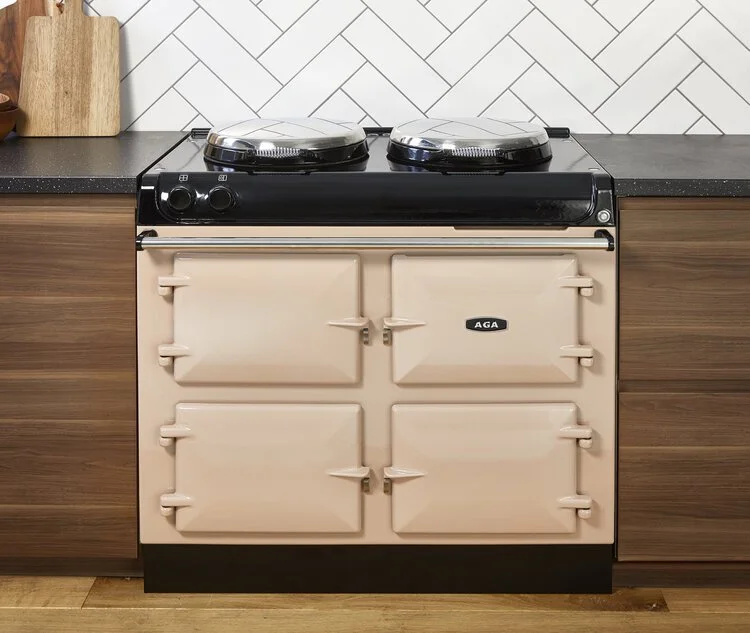
Construction plays a part in that feel too. AGA cookers are made from cast iron, including the ovens, hotplates and outer casing. Cast iron holds heat exceptionally well and gives that unmistakable solidity when you open the doors.
Everhot emerged in the 1970s as a fresh take on the traditional range. It keeps the warmth and charm of a heat storage cooker but introduces a cleaner, slightly more contemporary look. The lines are simpler. The styling feels lighter.
Structurally, Everhot cookers are primarily stainless steel, with cast-iron doors and hotplates. You still get the benefit of heat retention where it matters, but the overall build is engineered around modern electric control.
Both cookers can suit a traditional or modern kitchen, however if you want something steeped in history, AGA naturally appeals. If you like the idea of tradition with a modern twist, Everhot often feels like a better fit.
Cooking Experience: Similar Principles, Different Feel
Both Everhot and AGA use radiant heat inside their ovens. That means food is gently surrounded by consistent warmth rather than blasted by fan-driven air. It is brilliant for slow cooking, roasting and baking.
Comparing them directly can be tricky because both brands now offer multiple models. In particular, AGA has introduced more controllable electric versions in recent years, including the eR7 range, to improve flexibility and energy management.
That said, the traditional AGA experience still centres around fixed heat settings in the ovens. You choose which oven to use rather than adjusting a dial up and down. The hotplates also operate at set temperatures, which can make precise frying or simmering feel less intuitive at first. On fossil fuel AGAs, you also lose heat from the hotplates while cooking.
Everhot feels more adjustable. You can alter oven temperatures more easily, closer to how a standard electric cooker behaves, but still within a heat storage system. There is also grill functionality in the top oven, which some households really appreciate.
The hotplates have temperature control as well, making frying and simmering tasks simpler for people who want a bit more precision.
Energy Efficiency and Control
This is where the two brands tend to separate most clearly.
Traditional AGA models operate on stored heat and are typically designed to stay on, radiating warmth throughout the kitchen. That constant background heat is part of their charm, but it does mean higher energy use compared to a cooker that can be fully turned down.
Modern electric AGAs have introduced programmable features and energy-saving modes, but they still release more ambient heat into the room than an Everhot when set at similar cooking temperatures.
Everhot, by contrast, was designed around controllability from the outset. Its independent controls and ECO settings can make it easier to reduce consumption and thus running costs when full heat is not required.

Installation and Practical Considerations
The differences are not just about cooking. Installation matters too.
Traditional fossil fuel AGA cookers require a flue and regular servicing. Gas and oil models may need dedicated fuel lines, which can increase installation complexity and cost. Electric AGAs do not require a flue and do not need servicing in the same way, but they may still require more substantial electrical setup depending on the model.
Everhot cookers are designed to run from a standard 13-amp socket in many cases, which makes installation relatively straightforward in modern kitchens. No flue or expensive messy installation is required and no regular servicing is needed.
From a purely practical standpoint, that simplicity can make a significant difference during renovation or new kitchen projects.
Everhot or AGA: Which One Should You Choose?
If you love heritage, tradition and aren’t too concerned about high running costs, AGA is a solid choice.
If you want the aesthetics of a modern range with modern and control built in, Everhot often makes more practical sense.
The best way to decide is to experience them in person. These cookers behave differently from standard appliances, and that difference is hard to appreciate from photographs alone.
At F&R Fornello we stock a selection of range cookers in our showroom in Forest Row, Sussex. Whilst we don’t stock Aga cookers, you can find an impressive selection of Everhot, Bertazzoni or Lacanche range cookers on display. Book an appointment today - we would love to talk you through the different range cooker options available.